

Researched and Written by Katy Wicks - Happy Citta Founder

Psychological language is everywhere now.
We talk about being neurodivergent. About trauma responses. About narcissism. Sometimes casually, sometimes with judgement. But what happens when very different psychological patterns start to look the same on the surface?
“Am I just a narcissist?”
It’s a question I never expected to ask myself...
Psychological terms like neurodivergent, trauma response, and narcissist are now widely used in everyday conversation. While this shift has offered many individuals validation and a framework for self-understanding, it has also created confusion and, in some cases, an almost dangerous level of misinformed online education - especially when very different psychological patterns can look similar on the surface.
Behaviours such as defensiveness, emotional distance, impulsivity, or self-focus may arise from autism, ADHD, trauma, or self-protective responses linked to vulnerability and shame. But do any of us truly have the power to see the internal motivation behind the external behaviour?
Taking my attention away from the online conversations and looking a little closer to home, I noticed how easily people (sometimes kindly, sometimes not) would explain behaviour — mine, theirs, other people’s — by reaching for these labels. And at some point, I started turning that lens inward.
Some of my reactions felt automatic. Deep. Like something in me moved before I had a say.
Others, if I was honest, felt more deliberate. Chosen. Protective.
So that raises the uncomfortable question for me. But, wait... Why is the question uncomfortable?
Probably because, as mentioned earlier, some words have started to carry some very heavy stigma in the world, and narcissism is definitely one of them. But let's take a closer look at what we're really dealing with when we talk about narcissistic personality traits.
Understanding narcissism beyond the stereotype
When people hear the word narcissist, they often picture someone arrogant, selfish, or deliberately cruel. In reality, what psychology calls narcissistic patterns are far more complex and far more common than that stereotype suggests.
At its core, narcissism is less about loving oneself too much, and more about protecting a fragile sense of self-worth. People with narcissistic traits often feel deeply sensitive to criticism or rejection, and may respond by becoming defensive, self-focused, or emotionally distant. In its milder forms, these traits can show up as confidence, ambition, or a strong drive to be seen as competent — qualities many people recognise in themselves at times.
Clinical Narcissistic Personality Disorder sits at the extreme end of this spectrum, where self-protection becomes rigid and relationships are consistently strained. Importantly, these patterns develop through life experiences and relationships, not because someone’s brain is “wired differently” in the way neurodivergence is. Understanding narcissism this way helps move the conversation away from blame and towards curiosity — asking not “What’s wrong with this person?” but “What might they be trying to protect?”.
So, knowing that I have some reactions and behaviours that seem automatic and some that don't feel like they're at all within my control (and removing a little stigma from the naughty word above) how can I dig deeper and really understand - am I narcissistic or neurodivergent?
The Answer: "None of the above but all of them a little bit"
Well the internet, as we know, full of opinions, nothing tailored to me directly though. Maybe Chat GPT knows? Very helpful, but again, AI has largely been designed to serve our fragile ego as it is, so it almost feels like I'm defining the narrative myself.
Naturally, I looked for tools that might help me untangle this. Questionnaires. Online tests. Explain-it-to-me-simply guides.
What I found was either surface-level and vague, heavily biased towards one explanation or framed in a way that felt more judgemental than helpful.
There was nothing I could really hang a hat on — nothing that helped me understand why a behaviour existed, rather than just what it looked like.
So what did I do?
I decided to develop my own understanding. I spent several weeks researching the topic and the deeper I read, the clearer something became: these categories overlap far more than the internet experts suggest.
- Autistic people can look self-focused under social strain.
- Traumatised people can appear defensive or emotionally distant.
- People with narcissistic-style traits are often protecting a fragile sense of self, not necessarily lacking empathy.
- And trauma runs through all of it.
I decided to write a paper on my findings and then used that knowledge to develop a promising self-reflective tool, to help myself and others gain a greater understanding of their internal world.
The Two Outcomes
First, an academic paper that explores:
-
Where neurodivergence, trauma and narcissistic-style patterns genuinely overlap,
-
Why mislabelling happens in both directions,
-
Why ethical self-reflection needs more care than the internet often allows.
Second, a reflective questionnaire (not a diagnostic test) designed to help people explore:
-
What happens in them under pressure,
-
What feels most uncomfortable in conflict,
-
What their responses might be trying to protect.
It doesn’t tell you who you are.
It doesn’t give you a label to wear.
But it might just offer the introspective questions you've struggled to gain answers to.
You can read the full paper "Distinguishing Neurodivergence (Autism & ADHD) From Narcissistic Personality Traits" here:
You can go straight to the questionnaire, "Patterns in Neurodivergence, Self-Esteem and Safety" here:
As an example, you can see (a cropped version of) my own pattern summary below. Each section contains a little more detail, but just for the purpose of recognising how not a single label we can be:
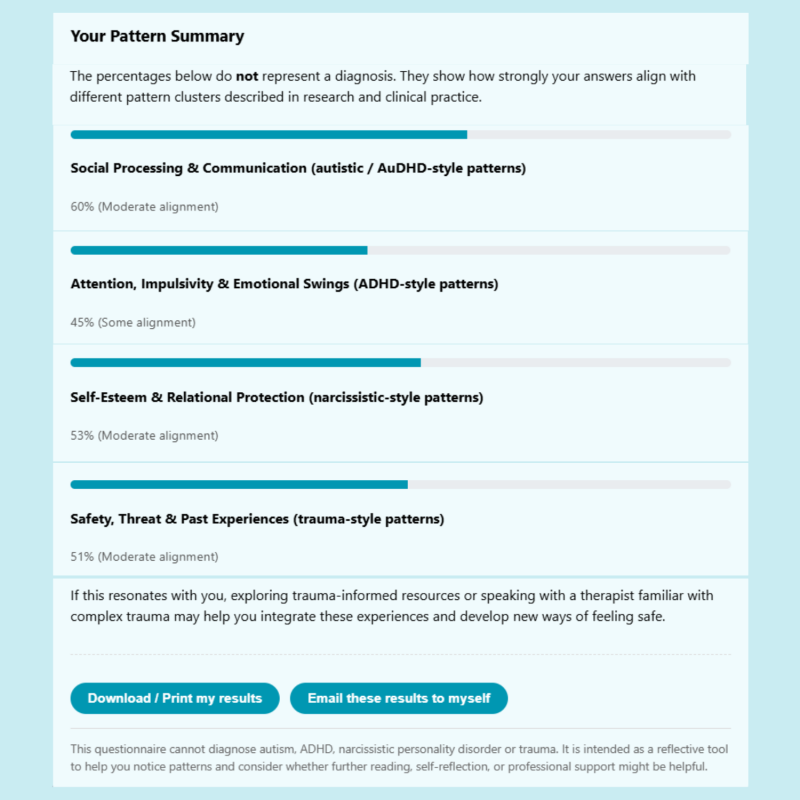
Let me know below if you've given it a try!
If you'd like help working through any of these issues, you can get in touch anytime below:
If you'd like to receive Happy Citta weekly blog posts along with the rest of the weekly subscriber newsletter, you can sign up here:
Add comment
Comments